Thursday, November 30, 2006

Quote Me


"Where humor is concerned there are no standards -
no one can say what is good or bad, although
you can be sure that everyone will."

--John Kenneth Galbraith(1908 - 2006)

Saturday, November 25, 2006

Time to Think Christmas

It is time for me to start thinking of Christmas and my annual Christmas card. Every one of the past few years I’ve written a poem and hand-made a book for it. I only send a few out (20-30) and only to a special few people. Last year was a tough year for ideas and this year doesn't look any better. I got to get to work.

Here is the first one from 2002, inspired by the great work of Edward Gorey


The Horripiláre Family Christmas

A is for ALICE, frigid cold and all soaking wet,
Should’ve stayed home and shopped by internet.

B is for BRAM, who waged war aside his G.I. Joe,
‘Til the toy land mine decided to blow.

C is for CAROL, who wished for a blue party dress,
Instead, she was crushed in her new wine press.

D is for DANIELLE, who tried to straighten the pine wreath,
When out jumped a bat with monstrous teeth.

E is for EDMUND, who went up the chimney to greet St. Nick,
And was smothered when the smoke got too thick.

F is for FELIX, from all manner of toy could he take a pick,
But, he vanished himself with his new magic trick.

G is for GRANDPA, who gives the holiday toast,
Even though last year he turned into a ghost.

H is for HORTENSE, who ate all the fruitcake,
It took an extra large coffin to complete the wake.

I is for IGNATIUS, who could have tried to walk, run or jog,
Rather than drive after drinking the spiked eggnog.

J is for JANICE, whose dolly seemed, oh, so real,
Fittingly, she fed her an arsenic meal.

K is for KRIS KRINGLE known over the world as Santa Claus,
Until eight mad reindeer taught him who’s the boss.

L is for LESTER, who waited for a kiss under the mistletoe,
And failed to hear them all call, “Look out below!”

M is for MARGARET, now trapped under the ice,
Her new pink skates did fit perfectly nice.

N is for NAOMI, who made cards full of Christmas greeting
But could not stop the paper cuts from bleeding.

O is for OSCAR, who wanted a friend for his lone guppy.
Alas, what he got was one rabid puppy.

P is for PRUDENCE, who tried to fix a broken ornament,
But inhaled way too much model cement.

Q is for QUINCY, poisoned by licking bad envelope glue.
Yes, I think I saw that on Seinfeld too.

R is for REGINALD, who got a patriotic American flag,
But preferred to play in the plastic bag.

S is for SIDNEY, who held onto the string so tight
And was carried away by his new box kite.

T is for TAYLOR, though the warnings were clearly plain,
Somehow got run over by his own toy train.

U is for UMA and her best friend URIAH,
Both died of boredom during Handel’s Messiah.

V is for VANETTA impaled on a Harry Potter broom,
And now encased in an oddly shaped tomb.

W is for WENDY, who was smashed under a gift,
She had not quite the strength to safely lift.

X is for XAVIER, who couldn’t wait to go out and play,
And promptly was hit by a runaway sleigh.

Y is for YOLANDA, Please try not to stare.
She hung herself by the chimney with care.

Z is for ZACHARY, who would survive to his surprise and shame.
For want of a happy ending, the author gladly takes the blame.

Tuesday, November 21, 2006

Paul Fleming, Magician, Economist, Communist(?)

The first hint of wrong was an article in the Chicago Tribune on September 3, 1946. The headline, “REVEAL ARMY TEACHES SOAK THE RICH IDEAS,” chilled the cold war conservatives to their wallets. The article follows: “An economic philosophy, embracing a cradle to the grave security financed largely by oppressive taxation of large estates and personal incomes, is being taught to men and women of the military services wherever the United States Armed Forces institute has set up a course in economics.”

The New York Times added, “ARMY COURSE SAID TO AID COMMUNISM.” Chicagoan and president of the National Small Businessmen’s Association, De Witt Emery accused the army of teaching Communism. He further called for an investigation of the “spineless, appeasing State Department,” and that it be “purged” of “radicals, Communists, and fellow travelers.”

The book, Economics: Principles and Problems, published in 1937 was the work of Paul F. Gemmill and Ralph H. Blodgett. Gemmill, a professor at the University of Pennsylvania, Blodgett a professor at the University of Illinois. Gemmill was a magician.

“BARE RED LINKS OF MAGICIAN IN ARMY TEXT QUIZ”
Chicago Tribune, October 6, 1946

“Paul F. Gemmill, magician and economist...is listed by the house committee on un-American activities as a defender of communism and sponsor of communist front organizations.” The article then lists several petitions that Prof. Gemmill signed including, a petition sponsored by the American Committee for Democracy and Intellectual Freedom demanding that the house committee on un-American activities be discontinued. In a move worthy of a current administration, the house committee described the former as a communist front operating among college teachers and professors.

Paul F. Gemmill was born May 30, 1889. Inspired by the great magicians of the day, he took up magic at a young age performing professionally by the age of seventeen. In 1909, Eugene Laurant hired Paul as an assistant. That was not Paul’s first choice; he wanted to work with another magician, his real idol, Karl Germain. Germain, Paul felt, was the best of all the magicians. A year later, Paul got his wish. He assisted Germain for four years and developed a life-long friendship with the master.

He toured as “James,” the assistant and as “star” under several names, Karl Germain, Paul Germain, and Paul Fleming. Germain lent him props and permitted him to use the Germain promotional materials, with slight alterations. Paul split time between performing and school. He was as good of a student as he was a magician and earned the respect of Germain. Karl, himself, being a hyphenate, magician-lawyer.

The textbook in question happened to be a standard text used in over 100 colleges and universities such as Notre Dame, Illinois, Kansas, Maine, Missouri, Cornell, Dartmouth, Stanford, Duke, and Vanderbilt. The criticisms were based on that they (Gemmill and Blodgett) advocated progressive income and inheritance taxation. Hardly a novel idea. Yet, it was banned by the army.

In those times, after the war, many people in many professions were caught by the red paranoia. Education and entertainment made for easy targets. Few survived unscarred. On any side.

Paul Gemmill continued, writing several other books. He died on December 30, 1976. His brush with “infamy” hardly spoken of in the magic community. He was a great magician.

That is all we needed to know.

Tuesday, November 14, 2006

Quote Me

"The profession of magician is one of the most perilous
and arduous specializations of the imagination. On the one hand, there
is the hostility of God and the police to be guarded against; on the other,
it is as difficult as music, as deep as poetry, as ingenious as stagecraft,
as nervous as the manufacture of high explosives, and
as delicate as the trade in narcotics."

--William Bolitho (1890–1930), British author

Thursday, November 09, 2006

The Four Rs

I'm in my late 30s, not that old. From this perspective at least. As a young child I heard about the importance of the three Rs. Of course in this form, reading, 'riting, and 'rithmetic, while charming, are hardly helpful to a developing child. Yet, we can't argue with the importance of all three. With two, writing and reading, I excelled. Arithmetic, I didn't. Funny, because I use math much more than I ever thought I would and am forcing myself to be better at it.

For argument, here are 4 Rs for successful magic:

Rehearsal

Re-examine

Refine

Rewrite

And lets add a fifth.....Repeat

In fact, they are just not for magic tricks.

Monday, November 06, 2006

The Last Sideshow? Final(ly)

Developing a show is a delicate alchemical process. A pinch of this. A dash of that. The formula is deceptively difficult to disinter. The variables so numerous, the combinations so exotic, and the blends so varied, there is no universal panacea. Yet, just as the alchemists were forced to follow a few immutable rules of nature, so must we performers do the same. To disobey is to create poison.

But there are different levels of poisoning, we ingest poisons every day. Most cause little to no damage, a few we embrace willingly. A show can be good or bad for many reasons: script, timing, emotional temperature, lighting, effects (choice of magic tricks, gags, etc.), costume, diction, acting, set design, price, marketing/promotion, or blocking. This list is just a broad overview.

You may even question some of these things, but the one wrong note could damage everything. There were two magic movies out this summer, The Illusionist and The Prestige. I liked both. Yet, while The Prestige may offer a better overall film, I liked The Illusionist better. Why? I believe it is because the two magicians in The Prestige were so loathsome I didn’t want either to have a happy ending. You might ask how marketing and promotion could damage a show, but perform the right show for the wrong audience and prepare to close early.

At this point, you are wondering what is this have to do with the wonderful sideshow previously described on this blog. I just want to remind my dear readers that developing a show is an art, not a science. It can happen by accident. It can happen by conscious choices. It can be great or it can suck. Sometimes it all comes together, sometimes it doesn’t. You might as well give your best try. A little honest self-examination goes a long way.

The problem is the show of our beloved sideshow doesn’t look honestly at itself.

I wanted it to be good. I dreamed it would be good. It is not good.

What frustrates me is that the mistakes are basic.

Step One, the personalities:
All the performers in the show are likable. That is the first hurdle. I made some specific critical remarks during my earlier narrative. The biggest problem is the worst talker is right up front, Prof. Chumley. He speaks with no energy, no excitement. He cannot hold the audience’s interest and get out the information he needs to get out. None of the inside performers are served by the sound system, which sucks.

Step Two, the script and blocking:
The words, when understood, don’t service the audience or the actions. There are several illusions in the show: Spidora, Headless Woman, Serpentina, the Four-legged Girl. These hoary old illusions are lame. It is especially confusing to the audience because the illusions are presented as real. They are not. If the audience could understand (or stand) the opening remarks, they would not have these confusions. If the illusions were presented with historical information in their individual introductions, there is no problem. I believe they might be more interesting if the audience knew their context. I had a customer in my store who loved Ricky Jay’s 52 assistants show. He said that is was special because not only is the magic good, but you also learn something.

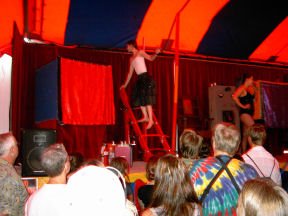
The second problem here is the blocking. The main stage is fine, but the side stages are well below the standing audience’s line of sight. The first couple of rows can see the rest cannot. The wonderful fire manipulation act of Madam Tea-Lee is marred because no one can see it. Sometimes the lack of direction causes the audience not to know where to look.

Step Three, the effects:
Perhaps we are not shocked anymore. Have the “reality” shows on TV ruined that? The danger effects in the show elicit a “ho-hum” from the audience. The tension of these thrillers does not exist. Some of this can be cured by proper blocking. When Prof. Chumley pounds the ice pick into his nose, he does it straight on. Instead, he should turn to the side or tilt his head down so the audience can see the ice pick’s journey into his face.

Nobody ever proves the Bed of Nails and the Sword Ladder is dangerous. Drop an apple on the fuckin’ thing, will ya’? Show us why we should care that you are doing what you do. Most of the illusions shown suffer from not being performed with the most basic of plot.

The guillotine never worked properly. BJ juggled knives and in every show dropped them.

Sideshow SideNote:
Let’s face it. Reading the various books on the sideshow gave me a romantic notion of the great sideshow performer, weaving a web of words to captivate and con their loving audience. The outside talkers do that. I have to put the performers in perspective. If they were any good, they wouldn’t be in the sideshow. I am sure a few fall through the cracks, a very few. I say this, all the while thinking I want to perform in the sideshow, but do it better. I know I can.

Step Four, the time:
Twelve acts. Thirty minutes. Slightly over two minutes an act. There is no time to properly present the individual acts. The show is destroyed in the process. The audience is cheated. The audience is disappointed.

It appears the presenters of the show do not care about their audience past getting their tickets at the door. Half the acts, presented well, would make a happier audience. Even P.T. Barnum knew to give the audience more than their money’s worth without cutting corners. Cutting corners cuts satisfaction.

In the old days of the sideshow these corners were not cut. When the Headless Lady was presented, all sorts scientific apparatus surrounded her. Today, a few ill-fitting pipes.

Why has the sideshow died? Forgetting what makes a show; they cut out their own art and amputated themselves to death.

Saturday, November 04, 2006

Quote Me

"Go to Heaven for the climate,
Hell for the company."

–Mark Twain

Sunday, October 22, 2006

The Last Sideshow Part 9

For us, the show is over. I am nearing the end of my sideshow adventure, but I want to reset the clock a little. I wanted you, dear readers, to get the sensation of the bally and the show first. Things did not happen in quite that order.

I met Ward Hall after I saw a show. It was one of his employees giving the bally when I first walked up. After watching the show twice, I left and Ward was onstage beating a bass drum to help draw the tip.

Introducing myself, I told Ward that I drove up from Chicago to meet him. He replied, “I don’t know why you would do that.” This is the first clue to Ward’s personality. He is humble and even as he speaks of his life and his accomplishments, it never sounds like bragging.

Ward took me into the tent and introduced me to who he could. We talked about sideshows, pitching magic, and exhibiting oddities. I got a good look at his Feejee Mermaid. Ward’s generosity impressed me.

To quote the cliché, he didn’t know me from Adam yet, treated me like an old friend. When I asked permission to record the ballys, he jumped up on the stage and spit one out, ad-lib. Unfortunately, our time together was too short. He, along with Poobah and Chris Christ, signed an old “World of Wonders” poster that I bought on Ebay. I asked if I could look him up in the off-season.

The quote goes something like this, “When a man dies, we lose a library.” Ward is the American library of sideshow. I wish to draw out a few volumes before that library closes. Even if I don’t see Ward down the road, I’ll never forget the few hours that I spent with him.

There is only one more part for me to write. It is the part I have been avoiding. I watched and listened to a half-dozen ballys and shows. Up until this last part, I have tried, with varying degrees of success, to hold any criticism. In the last part, I will discuss the good and the bad of the show. In addition, I’ll try to offer some solutions. See you next time.

Saturday, October 21, 2006

Halloween Quote me


"There is nothing funny about Halloween.
This sarcastic festival reflects, rather, an infernal demand
for revenge by children on the adult world."

--Jean Baudrillard


(fucking party pooper--bill)

Tuesday, October 17, 2006

Quote Me -- Halloween Edition

"Could it be that all those trick-or-treaters wearing sheets
aren't going as ghosts but as mattresses?"

-- George Carlin

Sunday, October 15, 2006

Last Sideshow -- Last Photos

The Headless Woman
(Diane in chair and BJ on left side, blue shirt.)

Bed O' Nails

(Lady Diabla prone with Madam Tea-Lee seated)

Looking into the Blade Box


The Sword Ladder with Ms. Diva

Saturday, October 14, 2006

The Last Sideshow? Part 8

Ms. Viva, after being shocked, arachnid-ized, beheaded, disembodied, and soon to be steel footed, will introduce only a single illusion. Looking in our imaginary sideshow almanac, it is another classic, appearing shortly after and directly related to Spidora’s creation. It is Serpentina.

To Ms. Viva’s right, she opens the raised cabinet to reveal a tree branch horizontally bisecting the interior. On the branch appears to be a large constrictor-type of snake, a long scaled body with the head of a woman. It must the half-twin sister of Diane, our sword-swallowing siren, because the faces match. Again, our view is momentary and Viva hides Serpentina away. The final act of the show is about to begin.

Madam Tea-Lee is her name. We’ve seen her twice already. First, when we walked in removing the blades from the blade box. Second, she sat on the reclining Lady Diabla as a climax to the bed of nails. At one time, the circus, the carnival, the sideshow provided safe (a relative term) haven for the odd, unusual, criminal, and disenfranchised of society. Many, uncomfortable in the “straight” world, find acceptance under canvas. Madam Tea-Lee is heavily tattooed and heavily pierced. Shocking, perhaps to patrons from the heartland, but not iconoclastic anymore. She is a sideshow cliché, de rigueur with the emergence of shock shows like Jim Rose’s.

That aside, Madam Tea-Lee is the best talker of the group. She begins her set by moving to the front of a side stage and performing fire manipulation. That’s a fancy way of saying fire eating. She does it as well as anyone. Marring her terrific turn, the act is performed at floor level, which prevents most of the audience from seeing it. After her act, she’ll move over one stage to her left.

On that stage, she reveals Bessie Howe, (not Vikki Condor as the banner advertised) the four-legged girl. Between sets, Lady Diabla has not only gained a new name, but also sprouted two additional, all-be-it temporary, legs. Diabla...Bessie...who-ever...becomes a one-woman chorus line performing a high kicking dance while seated in an enormous chair. Tea-Lee returns the audience to the main stage and the Ballerina of the Blades.

She directs our attention to a short ladder, its rungs replaced with swords. She bangs an extra sword against the blades to prove the reality of them. The sharpness of the blades is left to our imagination. Ms. Viva, now bare foot, ascends and descends the ladder, her feet unscathed their journey. Now, we return to where we came in, to the blade box.

Madam Tea-Lee opens the wooden coffin and Lady Diabla (sans extra appendages) returns to lie in the box. After closing and locking Diabla in, Tea-Lee will drop 13 over-sized blades into slots pre-cut in top of the box. There are three large blades and ten smaller blades. I can best describe them as big metal pizza spatulas without the long handles.

The first large blade slices the box in two. The second and third cut each half into half; the box is now quartered. The remaining ten blades penetrate the box in diagonal angles seemingly leaving no space for Lady Diabla to exist. But, Madam Tea-Lee assures us that, indeed, “this is not a magic trick. She (Diabla) is not under the box, behind the box, or vanished from this box.” In answer to the unasked question, Diabla’s hand slips up between the blades to wave.

“Lady Diabla is not a magician. She is a contortionist.” Madam continues. In order to perform this illusion, Lady Diabla must “bend, twist, fold, and contort her body around each of the blades.”

The story moves to the blow-off. We learn that this act is an extra feature. Lady Diabla performs this, her traditional family act, only by the good favor of the audience. For the price of one dollar and one dollar only, we can climb up on the stage, look into the box, and see her pretzel like condition.

Yes, I’ll pay my dollar and so will many others. I don’t do it for the cheap and badly photocopied souvenir postcard. I don’t do it to see how the trick works. I don’t do it to see a scantily clad woman snaked around the metal obstructions. I do because that is the thing to do. Madam Tea-Lee told the story and sold it well. Call it showman’s honor, if you will. I become a shill for the house and pay for the privilege. So will you, given the chance.

Madam Tea-Lee talks a steady stream. I am impressed. Some of the lines are long; she keeps the line moving, keeps selling the ding to stragglers, and keeps the interest in the rest of the room high. When the last of the curious depart, she begins to remove the blades. Tea-Lee talks on the subject of this being a continuous sideshow. She points out the exhibits to the right side of the tent including the replica skeleton of Ling-Mae, the Chinese giant woman.

Uncoiled, Lady Diabla receives her applause.

Madam Tea-Lee introduces Prof. Chumley and leaves the stage.

The show goes on.

Thursday, October 12, 2006

Quote Me -- Halloween Edition


"Nothing on earth so beautiful as the final haul on Halloween night."

--Steve Almond

Tuesday, October 10, 2006

The Last Sideshow? Part 7

BJ is the Tennessee Tuxedo to Chumley’s...um...Chumley. Later, Ward Hall tells me BJ works for Abbott’s Magic Company in Colon, Michigan. BJ has presence. He delivers his script with enthusiasm, even the corny jokes. Except, he lacks confidence in his material, almost apologizing after each groaner, rather than enjoying the moment. This fault is not only his own. I see it everyday in my store. After practically every joke, one salesman follows with, “Just kidding,” or “Hey, come on now”.

Being an improved speaker over Chumley, BJ handles a longer set. His first introduction directs us to stage right and a four-foot square curtained box on raised legs. It is a classic sideshow illusion. BJ does all but blow dust of it when he opens the curtain.

“She has eight legs, and I think that’s great. You should see her dance a jig. The head of a beautiful woman, the body of a spider, it’s Spidora.”

Spidora’s visit is brief. Her appearance is especially confusing to the audience partially because she is a twin of Ms. Viva and partially because the audience did not listen when Prof. Chumley told us that, there would be “illusions in the show, you’ll know them when you see them, and they are just for fun.” I don’t know what the rest of audience was expecting, but it wasn’t this.

We move from Spidora’s box on one end of the stage to the other end of the stage and the guillotine. This is an impressive piece of apparatus. Well-worn and stained, (perhaps with blood) thick timbers make up the frame. BJ cranks up the heavy blade with a click, click, click. Ms. Viva returns, yet again, and puts her neck at risk.

At the top of its rise, the blade automatically releases. The blade crashes down. Like watching slow motion replay rather than real life, Ms. Viva’s head slides down into the waiting box.

“It was less bloody in rehearsal,” BJ says.

The now disembodied head does not float over stage and sing a song. It does not even roll down the stage and answer questions. Instead, BJ struggles with the box that seemingly holds Ms. Viva’s flesh pumpkin. Next to the guillotine is a chair and a board stretches between the arms of that chair. BJ seemingly dumps the head of Ms. Viva out onto the board. She speaks briefly with BJ, but apparently, this part of the script was left up to the participants. The tête-à-tête is mercifully short. Viva is re-boxed.

BJ gets to show off his talents, next. He juggles knives. In the half a dozen shows I watched, he dropped them-- every show.

Trying to fit twelve acts into a half hour has advantages and weaknesses. The poor acts are over before the audience can hate them. Mostly. But, the good acts weaken without time for proper build up.

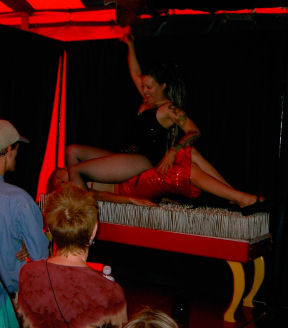
The audience’s attention redirects to a side stage. The curtain opens to reveal a bed of nails. A large bed of nails. I never have seen such a densely populated bed of nails. It reminds me of iron fur. BJ tells us these nails are real. I believe him. I'm in the business. Will the rest of the audience believe him without evidence to the contrary? With the fakery already observed, they would do better to prove the menace of the spikes.

Lady Diabla, the heroin chic girl who was in the midst of the blade box when we walked in, mounts the stage to lie upon the bed. She does to little response. The lack of implied danger to blame. Tea-lee, a heavily tattooed and pierced beauty, joins the stage and sits on the prone Diabla. There is a smattering of applause.

Back to center stage, BJ turns over the show to Diane. She swallows swords. They are real and examinable (both the swords and Diane, I imagine). Diane gulps down the first and removes it. She then swallows the second one. She bends at the waist, mouth wide to display the blade’s path. Diane finishes by allowing an audience volunteer to slide the sword out of her throat.

Diane turns the stage over to the most abused performer in the group, Ms. Viva. This time she will tell the tale instead of being the object of it.

Sunday, October 08, 2006

Lord Isaac Ackerley Butterworth-Toast

This poem is based on the poem, Colonel Fazackerley by Charles Causley. I did it as a writing exercise, rhyming quads instead of couplets. I thought it turned out fun.


Lord Isaac Ackerley Butterworth-Toast
bought an old castle complete with a ghost.
A resident, I’m sure, he rather not host,
especially him being more British than most.

It was a manor home beyond compare,
but why would a Lord risk such a scare?
You see, the estate seller failed to declare
to Ackerley that a spook was in there.

Late that first evening, while waiting to dine,
Lord Isaac was tasting a new sherry wine.
And just as the bell rang seven, eight, nine,
a light from no source began to shine.

Lord Isaac Ackerley could do nothing but gape,
at this oddly bluish translucent shape.
Thinking that perhaps it had just been the grape,
he wished, “Oh! for a blank video tape.”

From where, the Lord had not a clue,
came this light the fade color of blue.
It looked like a man, but in space it flew.
It could hardly be someone he knew.

“My dear fellow,” Isaac said, ‘that is really the best.
Can you do that long, or do you need to rest?
If so, then please, sit, be my guest.
And tell me your trick, I’ll not be a pest.”
At this, the dread ghost gave a hideous yell,
so deep and dark, like from the depths of hell.
“Please,” Isaac asked, “could be it a secret spell,
or something we can produce, package, and sell?”

The phantasm had then made a horrible face,
as it flew to and fro, all about the place.
It broke every plate, two mirrors and a vase.
It even tore the curtains of delicate white lace.

Isaac hardly could open his eyes to peek.
The Lord laughed, as tears run down his cheek.
“Here’s the entertainment for which I long seek,
and just as things were looking most bleak.

“My house-warming party I hope you won’t spurn.
I dare say, kind sir, you must give us a turn.
And please, dear fellow, don’t take me too stern,
but this fantastic trick you just must help us learn.”

And now, the poor spectre --quite out of his wits--
proceeded to shake himself almost to bits,
this man, he was giving him these terrible fits,
so he even tried singing some of Barry Manilow’s hits.

But Lord Isaac Ackerley, just as before,
was simply delighted and called out, “Encore!”
At which the ghost could stand no more,
and was never again seen on a castle floor.

“Oh dear, such a pity!” Isaac Ackerley said.
“I will certainly miss that dear old Ned.
He never was so much more alive, when dead.”
And thus, Lord Isaac Ackerly did away to bed.
Friday, October 06, 2006

The Last Sideshow? Part 6

“Professor Chumley” is well named, with more than a passing resemblance to the cartoon walrus. The first of three inside talkers, he introduces the show. The audience only half-listens to his lackluster speech. Fidgeting, the audience hardly stands in the same position or place for more than a moment. They want the wonders promised outside.

Chumley spiels on the history of sideshows, the “illusions” in the show, and the working acts that make up the modern sideshow. He warns us not to try any of this at home after which he pounds an ice pick into his nasal cavity with the microphone. The pick is just as quickly removed and our attention is directed to one of the side stages.

To the left of the main stage, there are three smaller curtained platforms. The one of interest at the moment is a smallish riser with a tall, narrow frame. The curtain, we will find, hides the first illusion of the show, The Headless Woman. And it is a beautiful woman’s body apparently without a head, just a mass of tubes where her neck terminated. It was only a brief display and we are back to the main stage.

Our Professor oversees one more act, the electric chair. A young sleepy-eyed girl (Ms. Viva) decked out in a cocktail party dress joins Chumley. The electric chair approximates the death seats seen in old-time prison photographs. Attached to the chair is a large box that apparently is the generator or the regulator or the something.

Ms. Viva sits in the chair. Chumley turns the switch. He assures us that voltage is now coursing through her nubile body. The only indication that anything is happening is a small light at the top of the box goes on. To prove the supposed electrocution, Chumley retrieves a four-foot fluorescent tube and holds it out for her to touch. As she does, it lights. Dimly. He runs the tube up her arm and down her body to her foot and it continues to glow faintly. The act is over and the second mc, BJ is introduced.